How to go from print to digital catalog effectively


Digital transformation isn’t about reaching a destination overnight. It’s about realizing the limitations of current workflows, the benefits of digitalization, and then gradually moving towards that.
This timeline illustrates a common progression many retailers follow in the digitalization of leaflets:
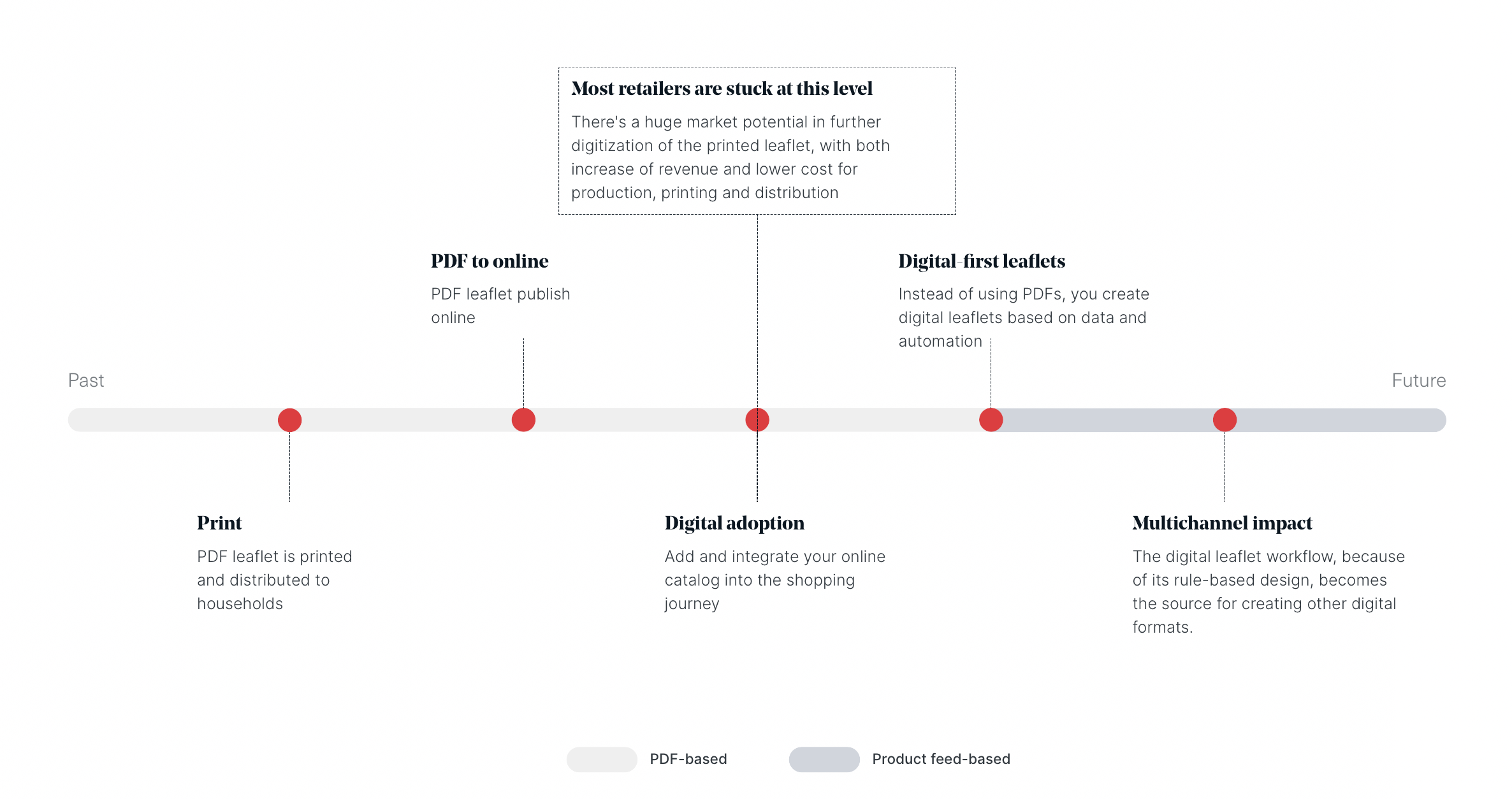
Each step on the timeline gives benefits to your organization and your customers. At the very end of the timeline, you'll be able to...
- Detach the digital leaflet workflow from the restrictions of print and PDFs
- Produce more digital leaflets faster, for example product categories or shorter validity
- Create several outputs for digital distribution, such as PNGs for paid ads
The beginning is typically traditional print production.
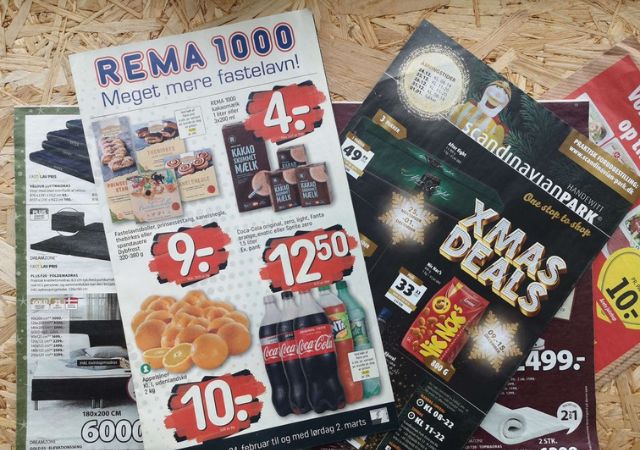
At this stage, retailers create a PDF leaflet that is printed and distributed to households. The print version is the primary campaign asset, and digital channels are secondary.
Since the print process is expensive and time-consuming, and ROI is going down, it’s only natural to go to the next step to gain more value from the format.
PDF to online – Expand reach online
The next step is often publishing the print PDF online.
Retailers can convert their print PDF into an online leaflet, making it available digitally without changing their existing production workflow.
This is often the first step toward digitalization because it allows retailers to:
• Extend the reach of their print campaigns and make digital leaflets accessible on any device
• Add interactivity such as links, videos, and pop-ups
At this stage, the workflow is still primarily print-first, but the content is now available digitally as well.
In our first six months we increased our leaflet sessions by 40% per week."
Jürgen Egger, Marketer, SPAR Switzerland
Still, with more and more shopping moving towards ecommerce, it’s only straightforward to consider whether digital leaflets can play a role there as well.
Digital adoption – Conversions and revenue
This is a more integrated strategy for the digital leaflets though still based on a PDF.
Digital adoption means incorporating digital leaflets into the customer journey - the digital leaflets facilitate conversions and revenue - and using digital insights to improve performance.
This often includes:
• Connecting products and leaflet basket to the ecommerce
• Using analytics to optimize future campaigns
This is where the digital leaflet can directly deliver measurable results in terms of sales.
10% of all global orders and 20% of all Oriflame products added to the basket are now through the digital leaflet. So, this is a significant way of selling and processing our orders.”
Marcus Fogel, Senior Director Global Digital Services, Oriflame
But, of course, the digital leaflet is still based on the print PDF. That means limitations in terms of how many and how fast digital leaflets can be created.
Digital-first leaflets – A new, efficient workflow
As digital becomes a larger part of the marketing mix, the focus should shift from publishing shoppable digital leaflets based on print PDFs to creating content specifically for digital consumption.
By seeing the results from the previous stage, the question becomes: "How can we create more digital leaflets faster and easier with the same resources?”
For many retailers, creating print PDFs more frequently is not an option. It’s too time-consuming and cumbersome.
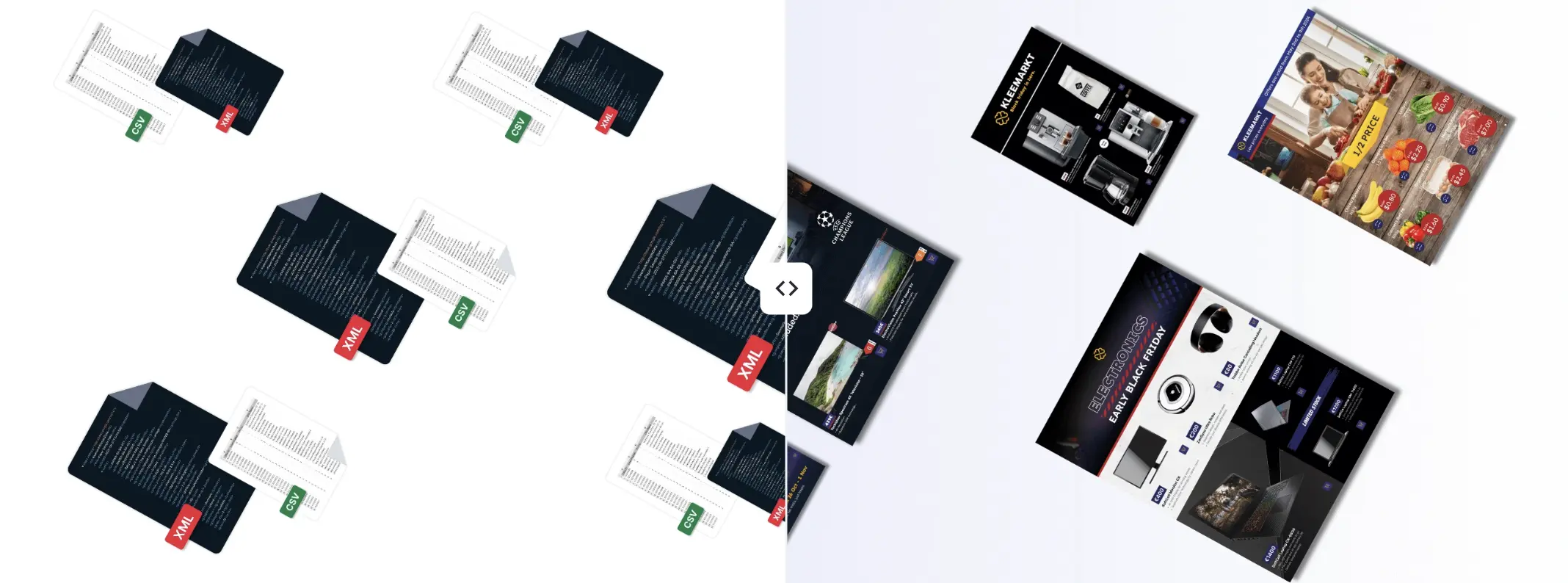
Instead, one should look towards a digital-first workflow: Creating digital leaflets based on automation and product data, not PDFs.
This gives faster production, more flexibility and enables automatic updates.
It makes the retailer able to run more inspirational online campaigns without relying on the print workflow.
10-4, a Danish DIY retailer, now creates biweekly digital leaflets and the results confirm that it's a format their customers want:
You can read the full case and the results here.
But, instead of running a digital leaflet workflow and separate production workflows for other digital content, such as ad images, why not create more online content from the new digital leaflet workflow?
Multichannel impact – Digital efficiency
This is a fully digital production workflow for all digital content.
Here, the digital leaflet acts as a central content source that automatically generates multiple outputs.
These outputs may include:
• Digital leaflets
• Digital PDFs
• Printable PDFs
• In-store signage
• Website content
• Other digital placements
Online content is created once and reused across channels. This reduces production effort and cost, while improving speed and consistency.
“We can now create digital leaflets at a lower cost with a one-week validity. We save money. When we create digital leaflets using our feed, we don’t need to work with an external agency.”
Eva Matoua, CMO, Conforama Switzerland
Summary
The print-to-digital transition is a gradual change rather than one big step.
Each step introduces new opportunities to improve efficiency, reduce manual work and create better customer experiences.
The goal is to build a workflow where digital can work without print and PDFs, with digital increasingly becoming the foundation for digital content creation and distribution.
In the end, whether a customer interacts with a digital leaflet, a landing page or a paid ad, the digital content originates from the same centralized, digital workflow.
And that will allow you to do more in less time.
Continue Reading

A new way to create online catalogs without a PDF
The biggest digital leaflet mistake (and how to fix it)
Your catalogs will be in good hands
- We have over 20 year’s experience working with digital catalogs
- Our dedicated team of experts are on hand to guide you to success